PTS — Society Project & Performance Management Platform
A full-stack project management system for university societies featuring per-project role-based access control, contribution analytics, deadline notifications, and a trilingual interface.
Project Overview
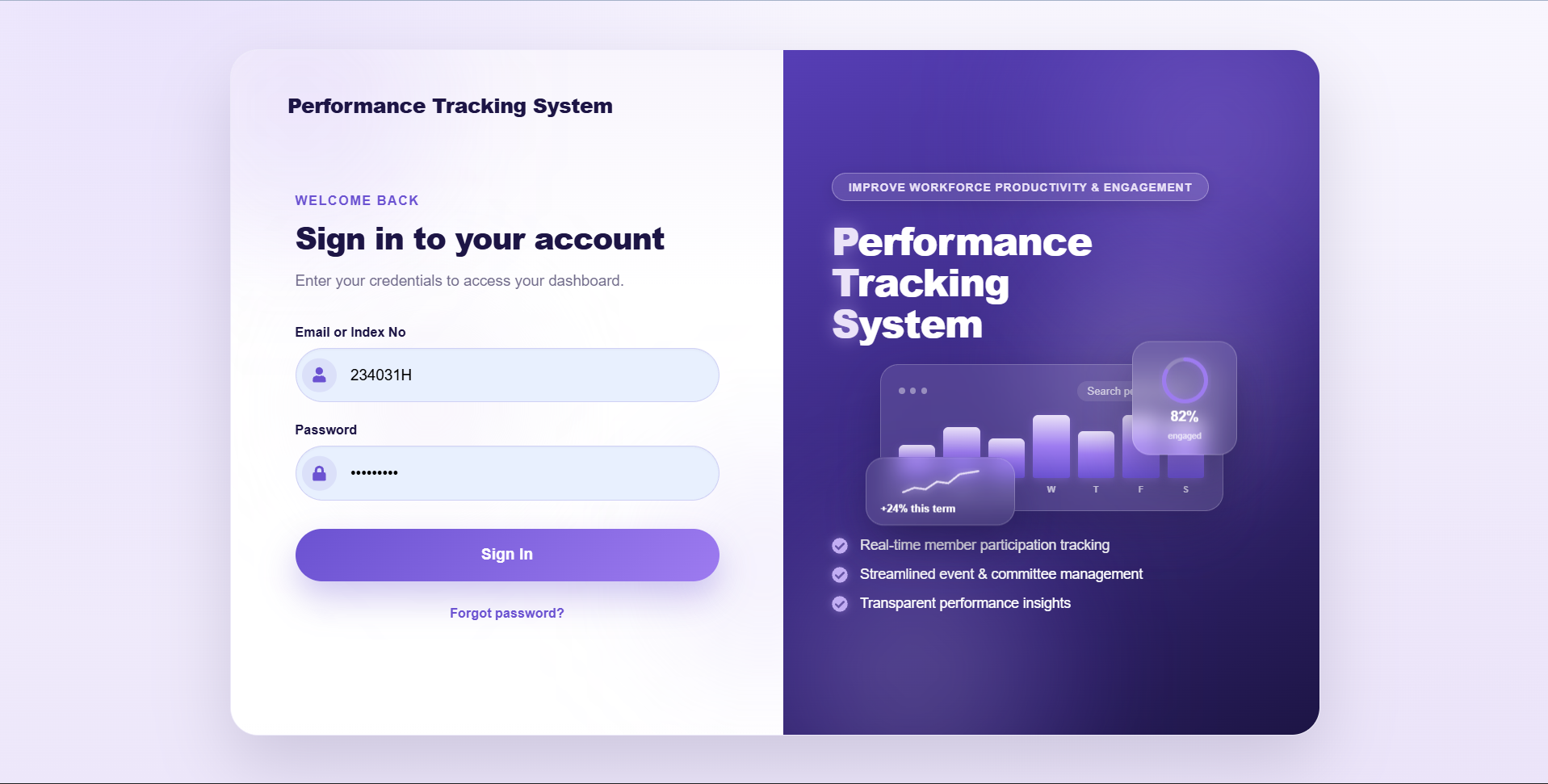
PTS (Performance Tracking System) is a full-stack web application built to manage university society projects and measure member contribution. It models the real organizational hierarchy — projects containing committees, committees containing members, tasks assigned to individuals — and layers role-specific dashboards, contribution analytics, and deadline notifications on top of it.
Problem Statement
University societies typically coordinate projects through spreadsheets, group chats, and informal follow-ups. Contribution becomes impossible to measure objectively, deadlines have to be chased manually, and no institutional record survives the term. Committee structures compound the problem: a chairperson may oversee several committees, each with its own lead and members, and none of that hierarchy exists in any shared system. The goal was a single platform where project structure, task ownership, and performance data live together and stay accurate without manual upkeep.
Project Goals
- Hierarchical Project Structure: Model projects, committees, memberships, and tasks using real database relationships rather than loose text matching.
- Per-Project Access Control: Support four roles (Admin, Chairperson, Committee Head, Member) whose capabilities differ per project, enforced server-side rather than merely hidden in the UI.
- Self-Maintaining Deadline Tracking: Derive overdue and upcoming-deadline state at read time instead of storing it, eliminating the scheduled jobs otherwise needed to keep task status truthful.
- Objective Contribution Analytics: Compute member performance scores and project health from real task completion data, weighted by on-time versus late delivery.
- Multilingual Accessibility: Deliver the full interface in English, Sinhala, and Tamil to serve the entire student body.
System Architecture
The platform is split into decoupled frontend and backend services communicating over a REST API:
- Frontend: React 19 with Vite, React Router for role-gated routing, and SCSS built on a centralized design-token system for consistent theming across ~22 pages.
- Backend & API: Node.js with Express 5, layered as Routes → Middleware → Controllers → Models, plus a dedicated service layer for cross-cutting concerns such as notification dispatch. Exposes 84 REST endpoints.
- Database: MongoDB Atlas via Mongoose, spanning 12 collections with ObjectId references, compound indexes on hot read paths, and aggregation pipelines powering analytics.
- Authorization: A two-tier middleware design — the first tier verifies the JWT and loads the live user record, the second resolves the caller’s role within a specific project into a declarative capability set that route guards check against.
- Authentication & i18n: JWT bearer tokens with bcrypt hashing and an invite-based onboarding flow using single-use expiring tokens, paired with react-i18next serving three locale bundles of roughly 950 keys each.
Key Features
- Project & Committee Management: Chairpersons create committees, assign members, and promote committee leads. Deleting a committee reassigns its members and tasks rather than orphaning active work.
- Permission-Aware Task Tracking: A chairperson may edit any task on their project, a committee lead may act within their own committee, and a member may only update tasks assigned to them — evaluated per task, not per route.
- Deadline & Assignment Notifications: Members are alerted to task assignments, completions, and approaching or missed deadlines, with overdue tasks escalating to the responsible chairperson and to administrators.
- Contribution Analytics: Aggregation-driven KPI cards and scorecards showing project progress, task velocity, and member performance weighted by on-time completion, filterable by month, quarter, or year.
- Society Calendar: A shared calendar of events, meetings, special tasks, and deadlines with month-view indicators and automatic inclusion of project deadlines.
- Secure Invite Onboarding: Administrators issue set-password links where only the SHA-256 hash of each token is stored, so a database leak cannot yield working links.
Challenges & Solutions
Read State for Derived Notifications
- Challenge: Deadline reminders were computed live from task due dates rather than stored, which kept them accurate when a deadline changed — but left nowhere to record that a user had already seen one. Dismissed reminders reappeared unread on every poll.
- Solution: Introduced a lightweight dismissal record keyed on recipient, task, and reminder kind. The reminder itself stays derived, while only the acknowledgement is persisted — so dismissing a “due soon” alert still allows the later “overdue” alert to surface.
Permissions That Vary Per Project
- Challenge: A user’s authority is not global. The same person may chair one project, lead a committee in another, and be an ordinary member in a third, so a single role claim on the session token could not express what they were allowed to do.
- Solution: Built a middleware layer that resolves the caller’s membership for the requested project and translates it into a capability object, letting routes declare intent (
requirePerm('canManageCommittees')) instead of re-deriving role logic. Non-members receive 404 rather than 403 so the endpoint cannot be used to enumerate projects.
Choosing a Delivery Mechanism for Notifications
- Challenge: Notification delivery appeared to call for WebSockets, but the codebase had no real-time infrastructure and the alerts were low-frequency and one-directional.
- Solution: Evaluated WebSockets, Server-Sent Events, and interval polling against actual update frequency and payload size, and chose polling — avoiding persistent-connection management for a latency requirement measured in seconds rather than milliseconds.
Lessons Learned
- Designing permission systems where the API is the source of truth: the frontend decides what to draw, the middleware decides what is allowed.
- Preferring derived state over stored state, and recognizing the trade-off it introduces — accuracy comes free, but any acknowledgement state must then be modelled explicitly.
- Evaluating delivery mechanisms against real requirements instead of reaching for the most sophisticated option available.
- Structuring Mongoose model registration on a shared database handle, where inconsistent handles or filename casing surface as
populate()failures far from their root cause.